Artists
Kazunori Hamana
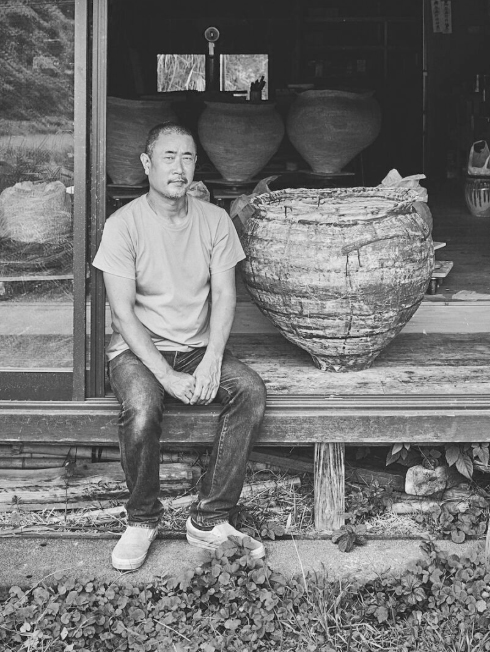
Kazunori Hamana is a Japanese artist whose monumental ceramic vessels exist somewhere between sculpture, ancient artefact and living object. Working from his studio on Japan’s Pacific coast, Hamana creates large-scale, hand-built forms that feel both prehistoric and distinctly contemporary. Their uneven silhouettes, weathered surfaces and earthy tones evoke objects unearthed from the ground or shaped slowly by the elements.
Hamana’s fascination with archaic ceramics, amplified by the fact that he is a passionate collector of antique Japanese ceramics, is palpable in his practice. He is re-establishing the notion of conventional form while embracing the essence of objects defined as vessels rooted in past associations with utilitarian wares. His series of works reflect an understanding of the fundamental principles of hand-built Japanese ceramics, characterised by the coil technique, though in his works the shape is being reinterpreted and reconfigured by the artist and the surface is, at times, covered with graphic calligraphy, geometric patterns and pure autonomous lines.
Drawing inspiration from traditional Japanese tsubo, functional clay jars dating back to the 12th century, Hamana creates large-scale dynamic vessels that transcend mere containers. Working highly intuitively, the artist explores the idea of containment within the vessel, seeing space and volume as important representations of the human body.